

My class at the Yale School of Music focuses on how today’s musicians can step into leadership and design ways to make classical music a vital part of our culture. Their learning vehicle is a semester-long collaborative project where like-minded peers explore, design, and test out innovative and creative solutions to this problem.
Leadership Models
The hands-on experience of creating and developing a collaborative project is a great way to practice different types of leadership. In a prior blog post, I described our 4-part model of leadership:
- Leadership from a Vision: having a vision and inspiring others to join in.
- Collaborative Leadership: collaborating with partners to lead in each person’s area of expertise.
- Servant leadership: coaching others and leading from behind to inspire and empower people to do their best.
- Leading from within or personal leadership. This inquiry involves the following elements:
-
- Positive mindset: The belief in yourself and optimism about the future, through flow, the growth mindset, and the SPIRE model of well-being.
- Authentic Leadership: A self-reflection on who you are at your core: your values, passions, and strengths.
- Purpose-driven leadership: Knowing your purpose and how you apply your talents and experience to make the world a better place.
- Connection: Once you connect with your purpose, you connect with others who share the same mission and set goals on how you can leverage your collective talents and experiences in service of your meaningful goal.
A key element of this inquiry is knowing your purpose. Not only does this clarify your own mission, but it also helps you to connect with like-minded people who share the same mission. In our class, the overlapping missions frame the way that my students create their collaborative project groups, which explore different ways of making classical music a vital part of our culture.
Let’s examine the process by which my students have discovered their collaborators.
The Process of Vision to Purpose To Mission To Projects
We start with a vision of what the ideal world of the arts looks like. From this, students then develop their life purpose statements and create their mission statements. Finally, students share their mission statements to identify collaborators who share the same mission, and then form their project groups accordingly.
- The Vision of the Ideal World of The Arts
A vision is a statement of your ideal future state. Since my class explores how to make classical music a vital part of the culture, we envisioned the ideal world of the arts in an in-class brainstorming question of:
“Wouldn’t it be great if the world of the arts…?”
This question had students thinking about what was vitally important to them. Here are some quotes from our brainstorming session:
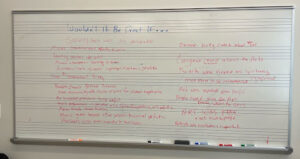
Whiteboard from the brainstorming session
My ideal world for the arts looks like a place where people recognize the deep spiritual, emotional, and societal benefits of the arts. This recognition leads people and institutions to ensure that the arts are well funded and accessible to all – tickets are cheap or free due to how well funded the whole system is. Artists are taken care of (well paid). Music education is a priority in schools.
In this world, The Arts are understood as a community act, a form of expression binding individuals to the community around them. Art is an inherently shared experience, and everyone plays an ‘affective’ (instead of observant) role in it.
In my vision of the Ideal World of Arts, the music we present resonates with the audience, and the feelings of being moved by the music in the moment are more important than the act of performing impressively. A concert is not done by the performers solely; there is always a sense of a joint effort by everyone in the room. There are many factors to help achieve this: building trust with the audience through strategic programming, conversations with the audience during and after the performance, and our own mindset of being.
In my ideal world, I am creating spaces through teaching, performing, and engaging in community projects to help create an environment where music is open to everyone, free from elitism and perfectionism. I would like to help people discover music as a source of joy and self-expression.
Reader’s Action Step:
To create your own vision of your future ideal state, simply ask yourself the same question:
“Wouldn’t it be great if …”
And then allow your imagination to run wild with what you would like your future to look like!
- Life Purpose Statements
I define life purpose as putting your talents and passions to work by serving others to make the world a better place. A life purpose statement flows from one’s purpose because it articulates your contribution to the world, along with the talents and passions that you use to make that contribution come to life. A Life Purpose Statement is not a job description. It is meant to be broad and apply to all areas of your life, not just your professional life. The more clarity you have around your purpose, the more success you will have in channeling your talents to make the world a better place.
From their vision statements, my students used a 4-step process to create their life purpose statements. This involves writing seven stories of joy and fulfillment, which highlight top talents and passions and the activities that feel purposeful. My students then shared their life purpose statements on our online bulletin board:
The purpose of my life is to unlock deep emotional power in others by transmitting my own emotional energy, which allows others to live deeper, more thoughtful, and meaningful lives.
The purpose of my life is to authentically, creatively, and compassionately forge deep and meaningful connections and inspire and empower curiosity and new cultural experiences in order to create a community through the universal language of the arts.
My purpose is to inspire and connect with other living beings through art and humble
conversation in order to create a world where every person can witness the power of humility and creativity.
The purpose of my life is to be constantly collaborating, connecting, and sharing with my sincerity, diligence, and positivity so that everyone feels safe and experiences joy, fulfillment, and connection.
I believe in the power of connection through the arts and music to inspire and instill curiosity, and I want to bring this into the world using my compassion, versatility, and open-mindedness, so that everyone has an outlet for free, creative expression.
My purpose is to create meaningful connections and inspire growth through music. By channeling my passions into action and using my strengths, I aim to support and collaborate with those around me, celebrating joy, positivity, and the shared journey of learning and creating together.
Reader’s Action Step:
Write your life purpose statement using the 4-step process and articulate the way you want to use your talents and passions to make the world a better place!
- Mission Statements
From the broad statement of purpose that encompasses your whole life, you can then create a mission statement that identifies the specific activity you undertake for a particular audience. A mission statement thus lays out three things:
- What I do
- For whom
- How they benefit
A mission statement is a win/win proposition. It enables you to live your life purpose, and it provides a benefit to the people whom you want to touch.
Here are a few examples of my students’ mission statements:
I organize awe-inspiring music for people who don’t get to hear it frequently so that they leave wanting to lead deeper lives and be better people.
I share my knowledge of music with broad audiences and students so that they experience emotional resonance and personal connection through music.
I collaborate and spread positivity with fellow musicians so that we feel fulfilled and connected making music together.
I create immersive, experiential contemporary classical music performances that bridge the gap between the performer(s) and the audience, aimed at reaching young music lovers who haven’t experienced engaging contemporary music yet. Audiences will leave these performances inspired, full of curiosity, and with a new love for the classical music of today.
I perform, teach, and create inclusive musical experiences for people of all ages and backgrounds, especially those who may not traditionally have access to music
so that they can experience joy, personal growth, authentic self-expression, and a deeper connection to themselves and their communities through music.
Reader’s Action Step:
What is your mission? You can have more than one! Think about the people whom you most care about working with, identify what you do for them, and then articulate how they benefit from what you do.
This is a great way to attract the right people to the work you most care about!
- Mission to Project Groups
The next step was for students to identify colleagues who shared the same mission and purpose. We held two in-class “speed dating” sessions where students interviewed each other to discover common missions. These sessions were really fun and resulted in three project groups:
- One group for “classically-curious” Yale non-music major students;
- A second group for Yale non-music major students for whom classical music would be a source of relaxation;
- A third group for Yale non-music major students who were curious and excited about exploring new genres of music informed by classical music.
These groups have been working together all semester to refine and develop their projects through the design thinking process. Not only is this experience teaching them how to solve complex problems, but it is also allowing them to practice different types of leadership.
Next time: I’ll break down how the project groups are practicing collaborative leadership.