
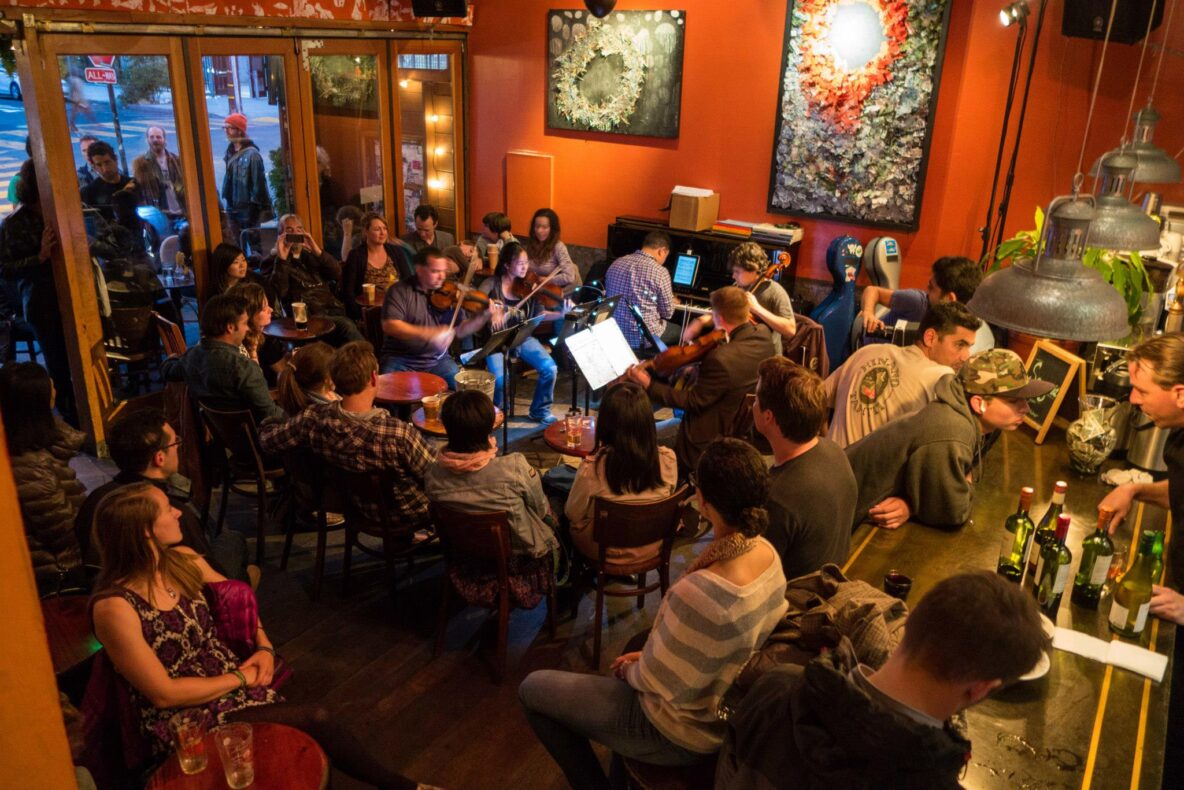
Last week, I attended Setting The Tempo, a fabulous event at the Yale School of Music in partnership with Yale’s Cultural Innovation Lab. The event highlighted performances and projects that capture the spirit of experimentation and collaboration, which define the interconnected nature of innovation in the Arts and Humanities at Yale.
The evening presented a workshop version of Red Helicopter: An American Rock Opera—a multidisciplinary adaptation of the global best-selling book Red Helicopter, created and produced by James Rhee, Yale Ventures’ Entrepreneur-in-Residence and Artist-in-Residence in the Cultural Innovation Lab at Yale. This groundbreaking work brings together artist-led Intellectual Property, transmedia storytelling, and live performance, featuring music and performances by School of Music alumni and the ensemble Solaris.
As a prelude, Solaris—an ensemble developed in my 21st Century Arts Leadership class at the Yale School in partnership with Yale’s Tsai Center for Innovative Thinking (Tsai CITY) Launch Pad —opened the evening with a set of four contemporary classical works, highlighting their innovative approach to collaboration and performance in chamber music.
The Project Experience in My Class
I was particularly proud and excited that Solaris was chosen to be featured in this showcase because it was one of the three entrepreneurial projects that emerged from my class last semester. In class, we took a hard look at the problem of how to keep classical music alive and vital in our culture. My students were concerned that their non-music peers find classical music inaccessible, intimidating, and unwelcoming to non-musicians. All three projects explored a different approach to solving this problem.
To form their project groups, my students created their individual mission statements and shared their missions in our in-class “speed dating” session, to identify like-minded classmates. Doing so ensured that everyone in the group was committed to the same mission. The result was three project groups, all focused on creating performances for non-music students at Yale. Each group had a different hypothesis of what could work:
- Solaris: An ensemble dedicated to connecting with Yale non-music major students who were curious and excited about exploring new genres of music informed by classical music.
- “Classically-Curious,” a live themed musical event for Yale non-music majors who were familiar with classical music and curious to know more.
- Café Classical: A relaxing and approachable live music event for Yale non-music major students.
Throughout the semester, my students followed a rigorous design thinking process to create and develop their project ideas, all of which culminated in their performances at the end of the semester. Each group succeeded in creating an event that their audience members both enjoyed and wanted to experience again!
Here’s what my students learned about how to attract today’s audiences to classical music.
Group 1: Solaris:
Solaris is a music ensemble that seeks to attract non-music Yale students by bridging the gap between contemporary classical and popular music. Solaris commissions pieces from today’s composers and singer-songwriters and offers approachable contemporary classical music programming along with approachable programming, Solaris aims to create a community of young music lovers through live performance in intimate spaces with virtuosic performances and a “casual vibe” that combines storytelling, narration, and humor.
In addition to five members of my class, the group expanded to nine musicians, adding people who also contributed non-musical expertise. As a result, the project evolved from small chamber music arrangements to include both large-ensemble and small-ensemble pieces, with a consistent focus on aesthetics and intimacy.
The students partnered with Tsai CITY, whose mission is to inspire students from diverse backgrounds and disciplines to seek innovative ways to solve real-world problems via Tsai City’s Launch Pad, a multi-week incubator designed to help early-stage ventures gain traction with skill-building workshops, mentorship, and a vibrant community of innovators. Their other partner was the Cultural Innovation Lab at Yale, which empowers artists and creative entrepreneurs to build new ventures that enrich culture, drive economic growth, and transform the arts ecosystem. The Innovation Lab’s director, Frances Pollock, is a composer with a doctorate from YSM who mentored the students all semester.
To test their concept, Solaris gave three pop-up concerts as part of their class project: one in a soup kitchen, one at Tsai CITY’s headquarters, and one in a local café. They also leveraged social media to share their repertoire with target audiences and demonstrate how approachable classical music can be.
At the showcase, the group performed a composition and an arrangement from the group’s composer, a piece from the contemporary music repertoire, and a work from a student singer-songwriter. The co-founders gave a warm welcome to the crowd, introduced the members of the ensemble, and provided insightful commentary about each piece.
The group has already lined up performances for the rest of the year. They also have established partnerships to perform at the School of Management and the Jackson School at Yale.
It is exciting that Solaris intends to expand their presence throughout their time at Yale and beyond!
Group 2: Classically Curious: Shades of Snow
This group created an event for “classical curious” non-music students at Yale: students who were familiar with classical music but did not attend live concerts. The goal of the event was to provide an informal, live musical performance in an intimate space, allowing attendees to feel connected, warm, curious, and eager to learn more about classical music. The group chose the theme of winter and programmed selections from Schubert’s Die Wintereisse, along with carols and contemporary music. To enhance the winter theme, they also introduced poems from the book “Wintering” by Katherine May and exhibited a work of art, “One Cold Day,” by Yale artist Lucas Brown. The idea was to validate the universal theme of isolation we feel in winter, as well as the warmth and coziness of coming together indoors.
The event was held in the cozy living room of Miller Hall, a lovely facility at Yale’s Institute for Sacred Music (ISM) that set the stage for a warm, inviting evening. The room had comfortable couches, a nice piano, and enough room for the musicians to circulate and interact with the audience. Thanks to a grant from the ISM, the group provided food and drink. The group members invited friends and friends of friends, limiting the audience to 30 people.
As the audience members arrived, the group members welcomed them and spent some time getting to know each other. Once the music began, the musicians spoke about the pieces to highlight the winter theme and told the audience more about the composers. The event culminated with the musicians and audience members singing carols together. Afterwards, the party continued, with musicians and audience members celebrating the success of the event.
The feedback from the event was positive! Audience members loved the informality, the high quality of the musical performances, the well-developed theme, and the enjoyment of being together. In a post-event survey, 100% of the participants said that they would love to attend another event like this—a paid event at that!!
Group 3: Café Classical
The third project group set out to overcome the image of classical music as elite and inaccessible by creating a fun, welcoming, and approachable classical music event for non-music Yale students. The group targeted an audience of undergraduate and graduate students interested in classical music, whose experience ranged from those with little exposure to classical music to those with a deeper appreciation and understanding of the genre.
The group came up with the novel idea of creating a “music menu” from which participants could order, describing the pieces in relatable, surprising terms, often including the mood of each piece. They hypothesized that during finals week, their audience members would enjoy attending a relaxed, engaging event where they could enjoy music without the formality of a traditional concert hall. The group members marketed the event through multiple channels, including several Yale newsletters, posters, word-of-mouth, and personal outreach.
The event took place during finals week at Yale’s Good Life Center, a space on campus promoting student wellness. The space was warm, comfortable, intimate, and audience members enjoyed baked goods and tea to accompany the music.
While the group members were concerned that very few people would show up, they had a much larger audience than they expected, with 30-40 people in attendance. In fact, the room filled up before the 4 pm start time, and people stayed for the entire event, often without enough seating to accommodate everyone!
The program balanced music that felt familiar and easy to enjoy, with music that showed the depth of classical performance. Three members performed, while one member of the group ran the venue and took the “orders” from the music “menu”. The performers spoke with the audience members throughout the event, interspersing comments about the music with their performances, and the conversation continued with audience members after the music was over.
The audience members expressed their gratitude for how beautifully everyone played. They also mentioned that they would look forward to having more of these kinds of events. In fact, in a post-event survery, 100% of the participants indicated that they would return for another concert. The Good Life Center also gave great feedback and invited the group back to perform this semester. So, the event was a success!
Learning from the Projects
Despite the different types of music events that the three groups created, there were certain common themes:
- Performance in unusual and intimate spaces
- A casual “vibe” in unexpected locations
- Breaking the wall between the musicians and the audiences
- Relatable music with virtuosic performances
- Food and drink
- Leveraging partnerships around Yale
As presenters grapple with the question of how to attract more people and younger people to classical music, these elements are worth exploring to shake up the elite and inaccessible conventions around this great art form!
**********************************************************************************
Through the creation, development and implementation of their projects, my students also experienced different types of leadership. Next time, we will take a look at collaborative leadership, followed by servant leadership, and culminating in a wrap-up of my students’ leadership experience. Stay tuned!